Anxiety Relief Bundle: Calm Tools You Can Print & Use
The Anxiety Relief Bundle: A Path to Calm
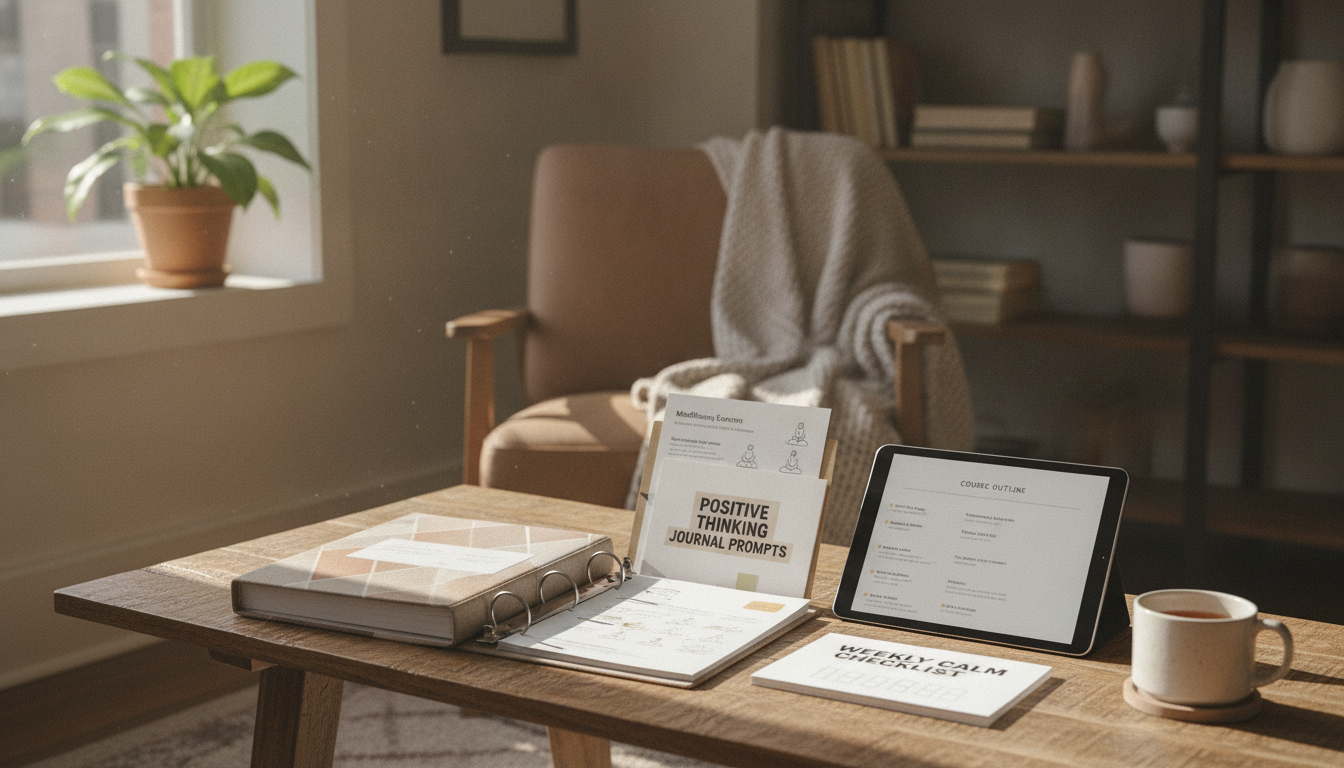
Anxiety can feel loud—like your brain won’t stop scanning for problems, your body is stuck in “on” mode, and even simple choices take extra effort. The Anxiety Relief Bundle: A Path to Calm is a structured, printable set of tools designed to make calming practices easier to start and simpler to repeat. This 4-in-1 bundle combines mindfulness exercises, positive-thinking prompts, a ready-to-use checklist, and a course-style outline to support steadier days and clearer next steps.
These tools are educational and practice-based—not a replacement for medical care. For trustworthy background on anxiety, visit the National Institute of Mental Health.
What’s included in the 4-in-1 bundle
- Mindfulness exercises to help shift attention away from spirals and toward the present moment
- Positive-thinking activities that encourage balanced, realistic reframing (not forced optimism)
- Printable checklist for quick wins, daily tracking, and gentle accountability
- Course outline to guide a step-by-step learning path, especially helpful when motivation is low
- Designed for repeat use: print, annotate, and revisit during stressful seasons
If you enjoy structured self-guided systems in other areas of life, The Empowered Budgeting Toolkit is a practical companion for building calmer money routines—especially when financial stress is part of the anxiety loop.
How the bundle supports calm when anxiety feels loud
- Creates a routine: small, consistent practices often feel more doable than big lifestyle overhauls
- Reduces decision fatigue: prompts, structure, and a clear sequence mean fewer “What should I do now?” moments
- Builds awareness: simple reflection and tracking can reveal triggers, patterns, and what actually helps
- Encourages regulation skills: breathing, grounding, and attention training that can be practiced almost anywhere
- Makes progress tangible: action (checklists) plus mindset work (reframing) helps you see change over time
Mindfulness is widely studied as a supportive practice for stress and attention training. The American Psychological Association’s overview of mindfulness is a helpful reference for understanding why brief practices can still be meaningful.
Mindfulness exercises to use in real life
When anxiety spikes, the goal isn’t to “win an argument” with your thoughts. The goal is to steady the body and gently guide attention back to the present—again and again, without judgment.
- Quick grounding for acute moments: name 5 things seen, 4 felt, 3 heard, 2 smelled, 1 tasted
- Breath pacing to lower intensity: inhale 4, exhale 6 for 2–5 minutes (keep it comfortable—no straining)
- Body scan to release tension: check forehead, jaw, shoulders, chest, stomach, hands, legs; soften what you can
- “Leaves on a stream” observing: notice thoughts without arguing with them, then return to the breath
- Micro-practice approach: 60–120 seconds still counts, especially on busy days
A useful rule for hard days: make the practice so small you can’t talk yourself out of it. Two slow breaths plus one grounded observation (“My feet are on the floor”) can be a real reset.
Positive thinking that stays grounded
“Positive thinking” works best when it’s realistic—more like balanced thinking than motivational slogans. The bundle’s prompts steer you toward reframes that your nervous system can actually accept.
- Replace absolute thoughts (“always/never”) with specific statements (“right now,” “in this situation”)
- Use evidence checks: what facts support the worry, and what facts don’t?
- Try compassionate self-talk: speak to yourself the way you would to a friend under pressure
- Build a coping-statement bank (e.g., “This feeling is uncomfortable, not dangerous”)
- Celebrate small proofs of progress: consistent practice beats perfect practice
Over time, this kind of reframing can reduce the “second arrow” of anxiety—the extra layer of shame, panic-about-panic, or self-criticism that makes the original feeling much bigger.
Printable checklist: turning good intentions into repeatable habits
When anxiety is high, planning can feel like pressure. A checklist works differently: it acts like a gentle external brain—simple, visible, and repeatable.
Simple 7-day calm plan (mix and match)
| Day | Mindfulness (2–5 min) | Mindset (2–5 min) | Checklist focus (1 min) |
|---|---|---|---|
| Day 1 | Breath pacing (4 in / 6 out) | Write 1 balanced thought | Choose 1 daily non-negotiable |
| Day 2 | 5-4-3-2-1 grounding | Evidence check on 1 worry | Track sleep or caffeine |
| Day 3 | Mini body scan | Coping statement practice | Plan one small break |
| Day 4 | Mindful walk (notice 10 details) | Replace “always/never” wording | Note one trigger |
| Day 5 | Observe thoughts for 2 minutes | Self-compassion note | Prep a calming space |
| Day 6 | Breath + shoulder release | List 3 things that went okay | Review what you used most |
| Day 7 | Choose a favorite practice | Set next week’s intention | Simplify: keep only what works |
Using the course outline as a step-by-step path
If you’re unsure what level of support is appropriate, the NHS overview on anxiety offers a clear, practical description of symptoms and support options.
Who it’s for, and when to seek extra help
Shop the bundles
- The Anxiety Relief Bundle: A Path to Calm | 4-in-1 Bundle | Mindfulness Exercises, Positive Thinking, Printable Checklist & Course Outline
- The Empowered Budgeting Toolkit | 4-in-1 Bundle| Budget Planner & Excel Guide| Monthly Expense Savings, Wealth Strategies & Guided Affirmations for Wealth
FAQ
Is this bundle suitable for beginners?
Yes. The tools are structured and designed to start small—many practices take just 1–5 minutes—so you can build consistency without needing prior experience.
How do the printable checklist and course outline work together?
The course outline provides a step-by-step sequence for learning skills, while the checklist turns those steps into simple daily actions you can track and repeat.
Can this replace therapy or medication?
No. It’s an educational self-help resource that can complement professional care, but it doesn’t replace diagnosis or treatment. If symptoms are severe, persistent, or create safety concerns, seek support from a licensed clinician.








Leave a comment